
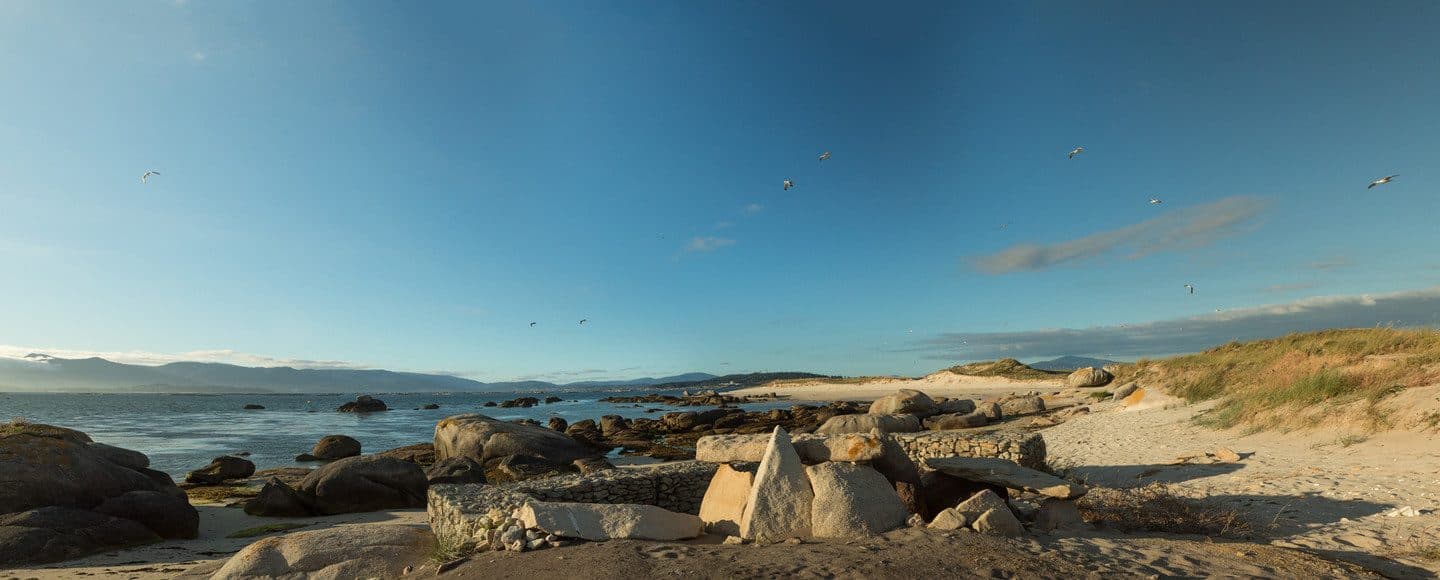
The beach on Areoso Islet is what many call the “Galician Caribbean”: very white sand, dunes and crystal-clear water in the middle of the Ría de Arousa. You cannot walk there: it is on a protected islet, it can only be reached by sea and landing requires an authorization from the Xunta. Here is what it is like, where it is and how to get there.
What Areoso beach is like
Areoso is small: about 600 metres from north to south, 200 at its widest and just 9 metres high, almost 9 hectares in total. The northern half is an active white-sand dune; the southern half mixes granite rocks with vegetated dunes.
Beyond the beach it holds archaeological heritage: several mámoas — megalithic burial mounds — and a dolmen that erosion has left exposed.
- About 600 m long and up to 200 m wide.
- Active dune in the northern half; granite and vegetation in the south.
- Megalithic mámoas and a dolmen.
- No facilities: no toilets and no drinking water.
Where Areoso is (map)
Areoso belongs to Os Guidoiros, a small group of islets in the Ría de Arousa lying about 1.4 km west of A Illa de Arousa (Pontevedra), the municipality it belongs to, next to Pedregoso islet and close to Rúa island. The whole group is a protected Natura 2000 site.
To see it on a map, search Google Maps for “Islote de Areoso”. The reference point on land is A Illa de Arousa, which you reach by car over the bridge from Vilanova de Arousa: that is where the kayak and boat trips leave from.
Getting there: always by sea
There is no bridge or path: Areoso can only be reached by boat. Landing requires the free Xunta authorization, with a quota of around 150 visitors a day split across three time slots.
- By kayak or paddle board: the most common way (two out of three visitors arrive paddling). Trips leave from Praia de Espiñeiro, in A Illa de Arousa, and the full route takes about 4 hours.
- By boat: the trip takes you to the islet, you land, enjoy free time on the beach and the boat picks you up at the agreed time.
- With your own boat: you anchor in the buoyed area and go ashore in a tender. Our anchoring guide explains how.
Time slots, season and tides
Visits are organised in three slots: from sunrise to 13:00, from 13:00 to 17:00 and from 17:00 to sunset. In high season — Easter week and from 15 May to 30 September — up to 50 people per slot are allowed on the islet; in low season, 20.
On very high tides the beach almost disappears and the Xunta does not authorize visits for those slots: if a date shows no availability, it may be the tide rather than the quota.
What you can do on the beach
- Walk on the sand and in the permitted areas.
- Swim and bathe.
- Snorkel on breath-hold, without weights.
- Fishing and scuba diving are not allowed within 200 metres of the islet.
Rules of the protected area
These come from the Xunta order regulating public use of Os Guidoiros (Order of 27 June 2023, DOG no. 125):
- No camping, overnight stays or bivouacking.
- No entry to the bird-nesting area in the south of the islet or to the fenced dune area.
- No animals (except assistance dogs), and no taking shells, stones, plants or archaeological remains.
- No fires, drinking parties or music devices.
- All your litter leaves with you.